
Iroquois: Almost There
A 1965 Henry C. Grebe power yacht, transformed by Stephens Waring Design.
She’s nearly ready. Here’s where things stand.
When Paul Waring first walked aboard Iroquois at Yankee Marina in Yarmouth, the boat had spent eighteen months under an unfocused restoration. Money had been spent. Progress had stalled. And the yacht, a 1965 Henry C. Grebe power yacht with real bones and a compelling history, was sitting in limbo.
What happened next is the project we’ve been quietly building toward for the better part of two years. It begins with the owner, Stephen, and a master boatbuilder, Richard Stanley, and a shared conviction that Iroquois deserved something better than a return to factory specification.

Escaping the Purist Trap
The word that kept coming back to Paul was restomod – borrowed from the automotive world, where restorers of Lincoln Continentals, Series Land Rovers, and Singer Porsches learned long ago that slavish period-correctness is often the enemy of a great result. Honor the DNA. Elevate the execution. Enable experiences the original never could.
Returning Iroquois to her original 1960s specification; flat-panel paint, varnished mahogany trim, simple cushions, linoleum floors, was never the point. The point was to discover what she could become in the hands of people who understood both where she came from and where design thinking has gone since. That philosophy drives every decision, from the doubled structural scantlings and custom aluminum engine beds below the waterline to the materials and finishes you’ll find above it.

The Interior
The reference points Paul reached for weren’t other boats. They were mid-century apartments in New York. Danish Modern sideboards. Eames chairs. Objects designed to be lived in, touched, argued over, not preserved behind glass.
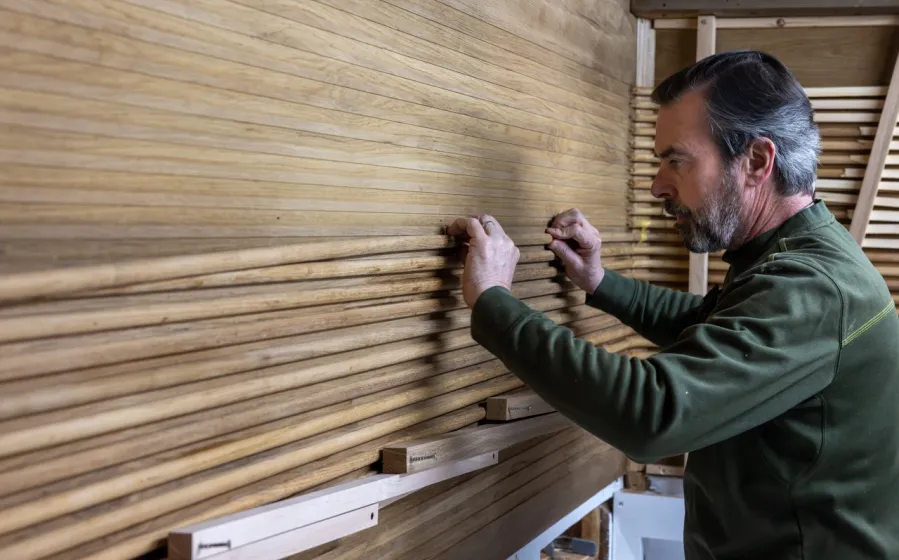
The interior that emerged from that thinking is built around Koa paneling balanced against handcrafted Acacia Walnut furniture. Leather-wrapped joinery against finished bulkheads. Horizontal material breaks that give each space a visual rhythm you don’t normally find below decks. In the owner’s cabin, the bed rests on a lit plinth, the mattress frame appearing to float, a detail that reads as effortless and required months to resolve.
“We explored unique ways to use leather and upholstery to create texture and depth,” Paul has described it. “The color balance, the contrast of materials should feel like a feast for the eyes, not a checklist.”

The Systems
The other half of the restomod equation is what you don’t see. Modern battery banks buffer climate control loads, delivering hours of silent running. The generator activates only when needed. Fuel management happens via touchscreen. One switch governs the entire water system. The helm station is deliberately minimal; two Garmin displays, engine controls, VHF, each with the complexity buried where it belongs.
“We’ve minimized the switch panel,” Paul explains. “What you see are a minimal number of buttons. Behind it is sophisticated engineering, but the owner just experiences an easy-to-operate vessel.”
Twin 590 BHP engines. Low-20-knot cruising. Starlink. AIS. Dual redundancy throughout. Invisible performance is the goal: systems sophisticated enough to think ahead, simple enough that the owner never has to.
Where Things Stand
Iroquois is in the final stages of completion at Yankee Marina in Yarmouth, Maine. She is on track for a July 2026 launch, with sea trials available by appointment ahead of that date.
She is available to view now.
If you’d like to arrange a private viewing or learn more, the full story, along with specs, photography, and additional video content is at buyiroquois.com.
To inquire directly: brokerage@stephenswaring.com or 207-460-0461.